Lesson orchestration for the classroom smartboard
No teacher can watch thirty faces at once.
NeuroCourse extends a teacher's power of observation. While you run the lesson, it follows the interaction happening in the room and shows you what you could not see. It does not take your place — it never speaks unless invited, and the floor returns to you the moment it is done.
- working end to end
- no student identity or face processed
- the teacher stays in control
One of 15 ventures selected for ETKİM Yıldızları, an accelerator run jointly by Türkiye's Ministry of National Education and YTÜ Yıldız Teknopark.
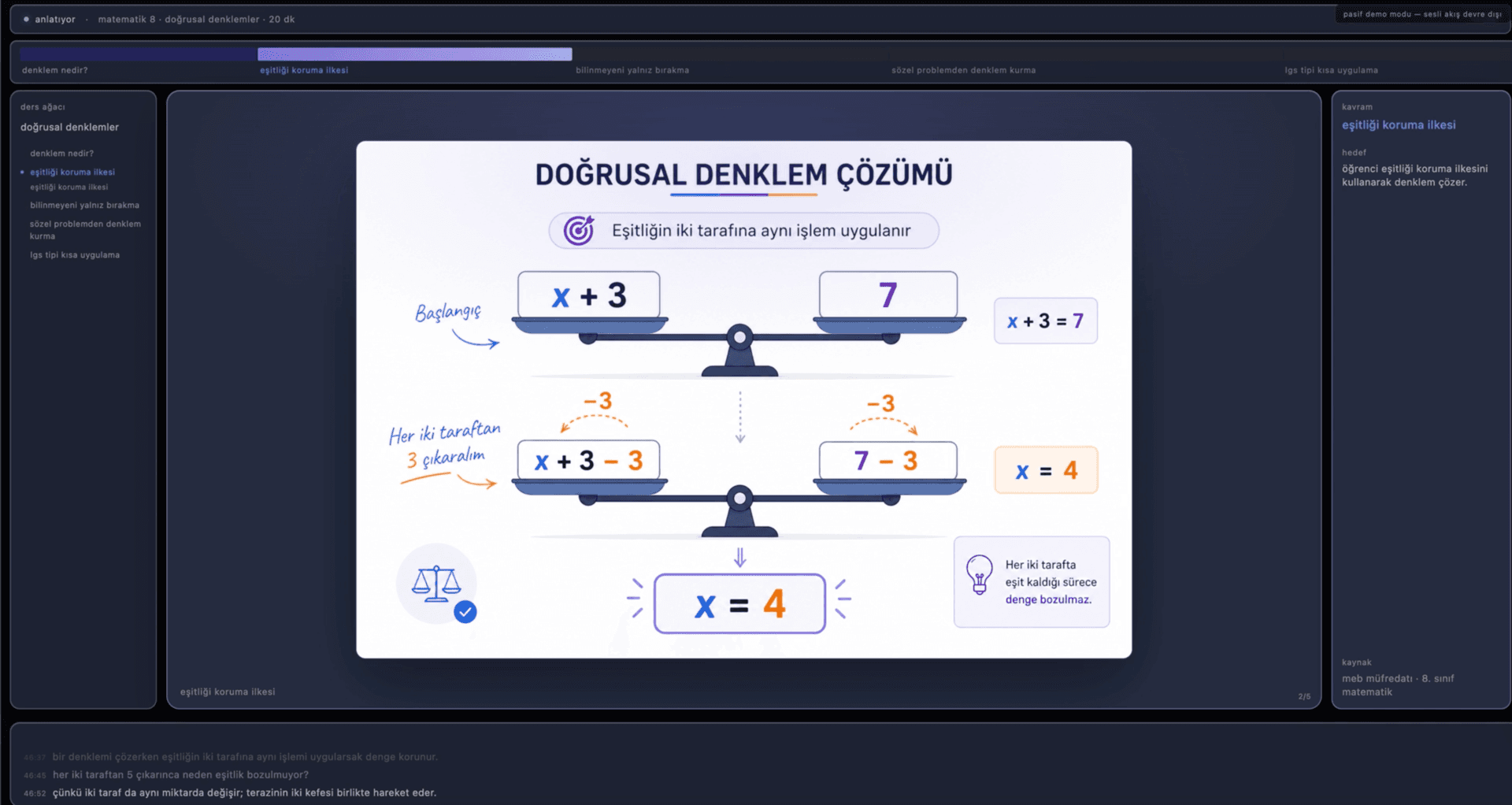
An actual product screen, running a Turkish-language lesson — not a mockup.
The human limit
This is not a shortcoming. It is a limit.
In a full classroom no teacher can look at thirty faces at the same time. That holds for the most experienced teacher in the school. Today, who struggled and where is usually discovered on an exam paper, weeks later — long after the moment when the decision had to be made.
- Today
- The signal arrives weeks later, on an exam paper.
- With NeuroCourse
- The signal forms inside the lesson and can be read the moment it ends.
NeuroCourse never flags an individual student. The signal is produced at class level and anonymously; no student identity or face is processed.
The pass
The AI does not speak unless it is invited.
Most AI products that reach a classroom push the teacher out of the loop — and teachers respond by not using them. NeuroCourse defaults the other way: the teacher teaches, the system waits. The floor moves only when the teacher hands it over, and only as far as the teacher hands it.
floor with the teacher
Four moments inside a lesson
This is the default state. The system is on but silent: it follows the flow and says nothing.
The teacher delegates: “work through this example”, “ask them this question”, “put this on the board”. The handover is explicit and scoped — the system gets exactly what it was given.
The class can interrupt. A student asks about the part they did not follow, without the social cost of raising a hand, and can write a solution on the board. The teacher is now observing rather than presenting.
As soon as the task is done the floor returns to the teacher, who can cut in, ask for a repeat or reject a suggestion at any point. The system does not argue.
Control commands are accepted only from the teacher's tablet. A command sent from the smartboard or any other device is rejected by the system — this is a protocol-level rule, not an interface preference.
A lesson
How a lesson actually runs.
01
Before the lesson
The teacher picks the class and the curriculum objective. The system drafts a flow for that lesson; the teacher edits it, removes what does not fit and approves it. Nothing the teacher has not approved reaches the classroom.
02
During the lesson
The stage opens on the smartboard. The teacher teaches and hands over the floor at chosen moments. A question from the class is handled without breaking the flow, and students can write their working on the board.
03
When it ends
What happened in the room becomes an action report: which section drew the questions, where the class interrupted, which step kept getting skipped.
04
The next lesson
The teacher builds the next lesson with the system, using that report. The plan is proposed, never imposed, and it goes through the teacher's approval.
grade 8 maths · linear equations
- The class interrupted most during “keeping both sides equal”.observation
- In three of the four worked examples, the same step was skipped.observation
- No questions came up on translating word problems into equations.not enough evidence
Where the evidence is thin the system makes no claim — it returns “not enough evidence”. That is a deliberate design decision.
Where we stand today
Objective-level inference of where a class struggled is still under development. Today the system records and summarises what happened in the lesson; turning that summary into an estimate a teacher can act on is exactly what the school pilots are for.
Who it's for
Three people, three different gains.
The teacher
Not extra work. Less of it.
The judgement you already make at the end of every lesson, the plan you already build for the next one and the account of your class you already give your department — the system writes all three down. Your instinct is not questioned; evidence is added to it.
The school
Shared visibility across sections.
How the same objective went in different sections becomes visible. The archive of lesson plans and the class map that accumulate belong to the school — they can be handed to whoever teaches the topic next year.
The student
Asking a question stops being expensive.
A student who will not raise a hand in front of the class will ask the character in front of them. Thirteen and fourteen year olds are at peak sensitivity to peer judgement; because the system flags no one, asking carries no risk.
Boundaries
What we are not, stated plainly.
NeuroCourse is not
- Not a replacement for the national learning platforms — we work inside the lesson they do not touch.
- Not a question bank, a mock-exam analytics tool or an exam-prep platform.
- Not building individual student profiles; it scores no one and grades no one.
- Not a system that decides in the teacher's place.
NeuroCourse is
- An orchestration layer that runs inside the live lesson.
- Teacher-controlled: the default state is the teacher teaching.
- Observation support that works at class level and anonymously.
- Aligned to the national curriculum; first focus is grade 8 mathematics.
Why now
Three things became true at the same time.
99%
of Türkiye's state classrooms have an interactive whiteboard
Türkiye spent fifteen years installing the hardware through FATİH, its national classroom technology programme: roughly 620,000 boards. NeuroCourse needs no new hardware — it runs on the screen already mounted on the wall. Few countries have a distribution surface this ready.
Ministry of National Education, 2024
2024
the year machines learned to talk at the speed of a lesson
Human conversation turns over in roughly two hundred milliseconds. Real-time speech pipelines only crossed that threshold in 2024. Only from that point could AI sit inside a lesson rather than beside it.
real-time speech, 2024
26
students per lower-secondary classroom — the OECD average is 21
A crowded room cuts the attention a teacher can give any one student down to minutes. Attention is the one resource AI can actually multiply.
Ministry of National Education / OECD
For a century, education technology waited at the classroom door: content libraries, homework systems, admin dashboards, assessment tools. The lesson itself — one adult, one board, thirty children, forty minutes — never changed. AI that can hold a conversation opened that door for the first time.
Trust
We claim only what we can stand behind.
A working system
Not a deck. The teacher console, the live lesson room, the smartboard stage, real-time speech recognition and synthesis, the state machine that drives the lesson and the end-of-lesson report all run end to end today.
No student identity or face is processed
The product is not built on student accounts, class rosters or camera feeds. The signal is produced at class level and anonymously. Data boundaries, retention periods and consent flows are agreed with the school in writing before any pilot begins.
Institutional footing
We are one of 15 EdTech ventures selected under E4J, a programme the Turkish Ministry of National Education runs with the World Bank, and we are part of the ETKİM Yıldızları accelerator. The product will be trialled in real schools under the Ministry's supervision.
What we do not have yet
We do not yet have measured learning-outcome data from a real classroom. That is why you will not find a sentence on this site claiming we raise attainment by some percentage. Through ETKİM Yıldızları we are preparing for the Ministry of National Education's school pilot process — that is where this evidence will be produced. Objective-level inference is still under development, and testing that claim is exactly what the pilot is for: where it does not hold, the product changes to match what the measurement says.
Questions
The objections we hear most.
Our school already has a learning platform. Why add this?
We do not replace it. Learning platforms are built around a student working alone; they do not touch the decision a teacher makes inside a live lesson. That moment is where we work, alongside whatever platform you already run.
Does this replace the teacher?
No. The default state of the product is the teacher teaching. The AI speaks only when the teacher invites it, the floor returns as soon as the task is done, and control commands are accepted only from the teacher's tablet.
What happens to student data?
No student identity or face is processed. The product is not built on student accounts; the signal is produced at class level and anonymously. Data boundaries, retention and consent flows are agreed with the school in writing before a pilot starts.
Is this endorsed by a ministry of education?
No, and we do not describe it that way. We are one of 15 EdTech ventures selected under E4J, a programme the Turkish Ministry of National Education runs with the World Bank, and the product will be trialled in real schools under the Ministry's supervision. The pilot certificate that process produces is not an approval for national rollout or a commitment to purchase.
Does it add to the teacher's workload?
It asks you for no data entry. It gathers the interaction the lesson already produces and hands back two things you have to do anyway: the plan for the next lesson and the class summary you present to your department.
Does it need new hardware?
No. The interactive board already in the room plus the teacher's tablet are enough; no student devices are required. A stable internet connection is required.
Does it work outside Türkiye?
The system is curriculum-driven rather than content-locked, so it maps to another curriculum by loading that curriculum's objectives. The product interface and the lesson language are localisable. We are in conversation with international schools and with institutions in the Gulf; talk to us about what your curriculum and your language of instruction would need.
How is it bought?
As an annual institutional licence, priced per class section. We start with a limited, paid term pilot; moving to a full licence is a conversation about what that pilot made visible inside the school. Pricing is agreed in that conversation, based on the size of the institution.
Contact
Let's see it in your classroom.
In thirty minutes we show you the product running live and work out together whether a pilot makes sense for your institution. Write to us from outside Türkiye too — we are talking with international schools and with institutions across the Gulf.
- A live demonstration of the product — the working system, not a recorded video.
- A pilot scope and timeline sized to your institution.
- Written answers to your data, consent and compliance questions.
Or write to us directly info@neuroqubitai.com.tr